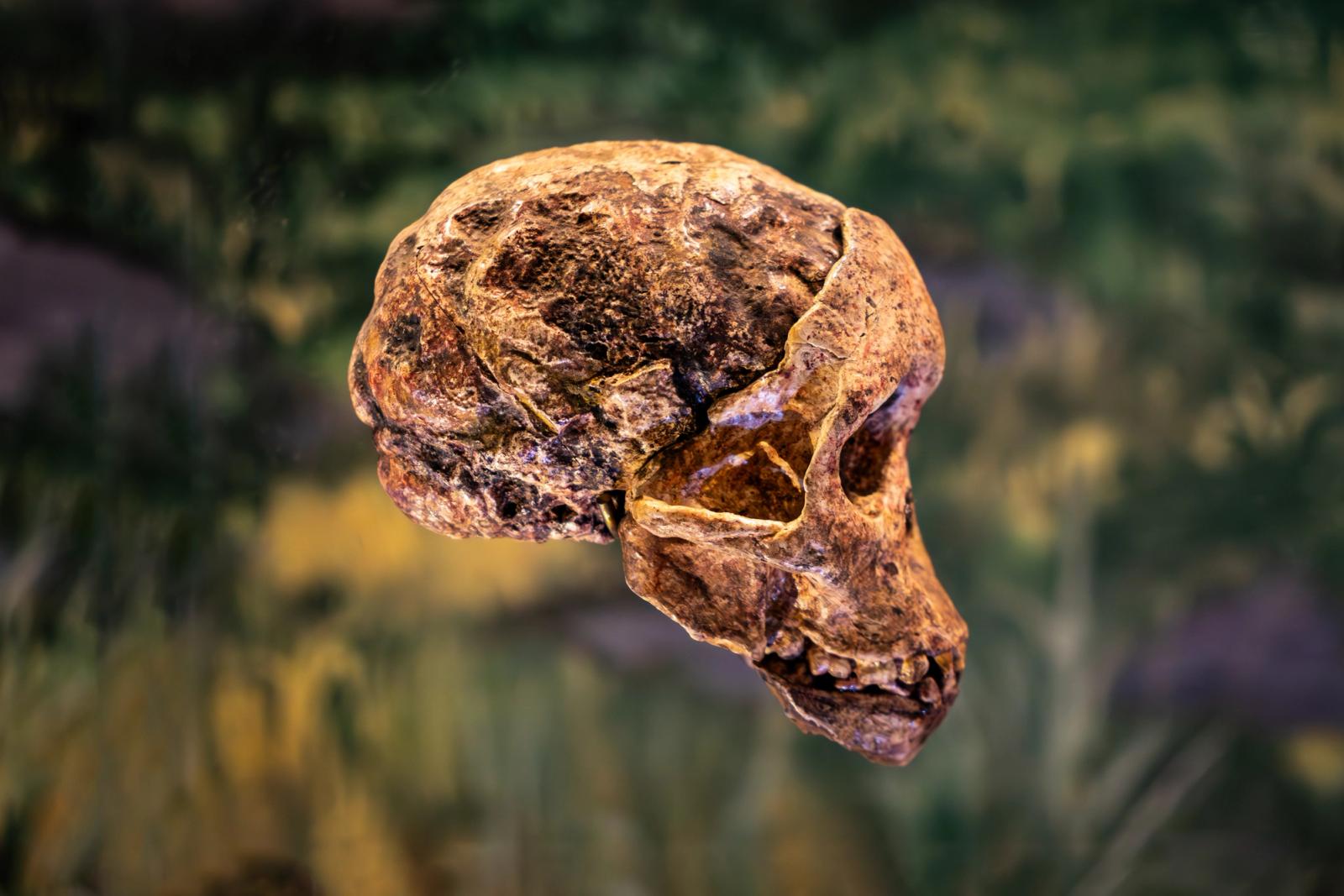
For fifteen years the Denisovans were known from teeth, jaw pieces and fragments of bone, and nobody could say what one looked like. Ancient proteins and DNA have now identified a nearly complete skull from north east China, at least 146,000 years old, as one of them.
For fifteen years the Denisovans had no face. Ancient DNA recovered at Denisova Cave in southern Siberia identified them in 2010 as an archaic hominin population, part of the human evolutionary group, distinct from Neanderthals though sharing ancestors with them around 400,000 years ago. Everything found afterwards was a fragment: teeth, pieces of bone, two jawbones and a rib, none of which say much about what a Denisovan looked like. In 2025 three separate studies converged on one object, a nearly complete skull recovered at Harbin in north east China and dated to at least 146,000 years ago, and placed it inside the Denisovan population.
How we know
Two of the studies worked on the skull itself. One recovered 95 proteins made by the individual rather than left behind by contamination, found three amino acid variants known from Denisovans, and clustered the Harbin individual with a Denisovan already sequenced at Denisova Cave. The other went after DNA, which had never been recovered from this fossil, presumably because of its age. A tooth yielded none. Neither did the petrous bone, one of the densest bones in the skull. So the team turned to dental calculus, the calcified plaque on a tooth, whose tight crystal structure shelters DNA from decay, and from 0.3 milligrams of it recovered mitochondrial DNA, the small circular chromosome that sits inside the cell's mitochondria and passes down the maternal line alone. It fell within Denisovan variation, closest to an early Denisovan branch already known from Denisova Cave.
The third study never touched the skull. That team had worked out what a Denisovan skeleton should look like by finding the gene activity changes likely to have altered Denisovan bone, then scanned the fossil record for skulls that matched the prediction. Of 18 predicted features, Harbin matched 16, more than any other hominin fossil of its period they tested, Neanderthals included. The nearest rival, the Dali skull, also from China, matched 15.
Why it matters
A population known only from teeth and jaw fragments is hard to place. A skull can be measured against every other fossil of its age, so the Denisovans now have anatomy that other finds can be compared with, and the jawbone from Baishiya Cave on the Tibetan Plateau, already tied to Denisovans by protein evidence, has a face to sit beside. The range widens too. Denisovan remains had come from a Siberian cave, from the Tibetan Plateau and from the Penghu Channel off Taiwan, and north east China fills in the middle, which the authors read as evidence that Denisovans occupied a wide stretch of Asia.
The method may matter as much as the result. DNA failed in a tooth and in dense bone and worked in dental plaque, which the team says opens genetic research on other fossils of this age, many of them long treated as too degraded to be worth trying. Before this, human DNA had been sequenced from skeletal remains at only four sites older than 100,000 years. Harbin makes five.
No nuclear DNA was recovered, meaning the DNA in the cell nucleus that carries ancestry from both parents. The identification rests on ancient proteins and on mitochondrial DNA, which follows a single maternal line, and the authors say nuclear DNA from fossils across East and South East Asia is what the wider question still needs. The mitochondrial result places the Harbin individual closest to the earlier Denisovans with low statistical support. The naming is unsettled too: earlier work on the skull's shape described it as a new species, Homo longi, or as a sister lineage to Homo sapiens, and mitochondrial DNA alone does not settle that.
What is a Denisovan?
Denisovans are an archaic human population identified in 2010, when ancient DNA from remains at Denisova Cave in southern Siberia proved to belong to a group distinct from Neanderthals. The two are sister groups and shared common ancestors around 400,000 years ago. Until this work every confirmed Denisovan fossil was a fragment, so nobody knew what one looked like.
Why did the DNA come from dental plaque?
The first attempts, on a tooth and on the petrous bone, one of the densest bones in the skull, produced no DNA at all. Calcified dental plaque has a tight crystal structure that shelters DNA from decay, and 0.3 milligrams of it yielded readable mitochondrial DNA. The authors say the same route could open other fossils of this age to genetic study.
Does this mean Homo longi was wrong?
It is not settled. The Harbin skull was previously described as a new species, Homo longi, on the basis of its shape, and other work proposed it as a sister lineage to Homo sapiens. The new studies show that its mitochondrial DNA falls within Denisovan variation, which is evidence about ancestry rather than a ruling on the name.
Three verified stories, once a week.
Good news, checked against primary sources. Free.
Powered by Buttondown