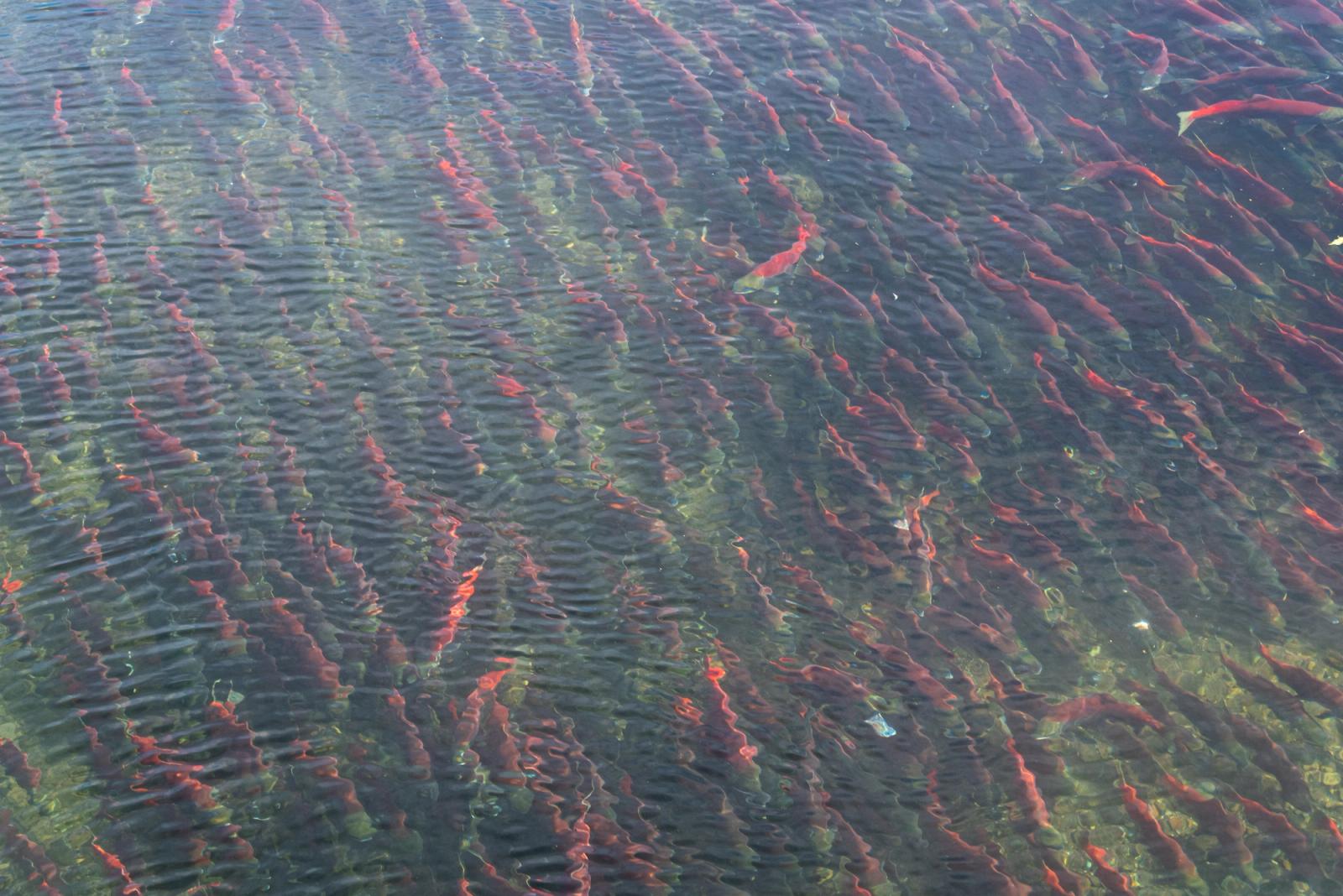
One year after the last of four dams came out of the Klamath River, 11,722 adult Chinook spawned above the old Iron Gate site, against 1,494 the season before. The run has climbed back above the population line federal managers watch.
For more than sixty years, a Chinook salmon swimming up the Klamath River met a wall of concrete near the California border and stopped. The last of four dams came out in October 2024. In the autumn of 2025, on a river that ran free for the whole spawning season, biologists counted 11,722 adult fall Chinook, the salmon that come in from the ocean to breed in autumn, in the mainstem and tributaries above the site of the former Iron Gate Dam. The year before, when the river opened only part way through the run, the count was 1,494.
How we know
The figures come from the Pacific Fishery Management Council, the federal body that sets ocean salmon seasons off California, Oregon and Washington, in its annual review of the 2025 fisheries. They are escapement counts: the tally of fish that get past every net and hook and reach the spawning gravel, which is the number salmon managers steer by rather than the catch. Across the whole basin, 39,860 adults reached natural spawning grounds in 2025, up from 24,032 in 2024 and more than double the 19,417 the Council had forecast before the season. The work behind the numbers is patient and physical: video weirs on the Shasta and Scott rivers, walked surveys of the spawning reaches, and counts of redds, the gravel nests the females dig. California's Department of Fish and Wildlife put 1,304 adults in the Salmon River, part of a basin total of 2,153 fish that was about 22 percent up on the year before, and the Karuk Tribe helped complete the mainstem survey.
Why it matters
A dam removal is a bet that a river will do the rest of the work itself. The bet is being settled in fish. In 2018 the Klamath fall run was declared overfished, a formal status meaning the population had fallen below a set threshold, not that boats were taking too many. The test is a three-year average of escapement: for 2022 to 2024 it stood at 27,947, under the line, and for 2023 to 2025 it is 34,093, over it. On that measure the Council now classes the run as no longer overfished and rebuilding, the middle of three statuses and one step below the mark it would call rebuilt. What the salmon did above Iron Gate they did without being carried, released or coaxed. Given the gravel, they went and found it.
The run is recovering, not recovered. The Council treats a stock as rebuilt only when the three-year average of natural spawners passes 40,700, and the current average of 34,093 is well short of that. The Shasta River, historically the most important Chinook stream in the upper Klamath, drew 5,562 adults in 2025 against 27,600 as recently as 2012 and 63,700 in 1935. The Salmon River's 1,304 adults made 2025 the eighth year since 2016 below 1,500 fish, and its total run ranks 24th in a 48 year record. One strong season also says little on its own: Chinook return on multi-year cycles, ocean conditions swing the numbers, and the 2025 monitoring was itself thinned by a federal government shutdown from 1 October to 12 November and by funding cuts to fall Chinook survey work.
What does "no longer overfished" actually mean here?
It is a formal status under United States fisheries law, based on how big the population is rather than on how much fishing is happening. A West Coast salmon stock counts as overfished when the number of fish reaching its spawning grounds, averaged across three years, sits below a set threshold. The Klamath fall Chinook average rose from 27,947 for 2022 to 2024 to 34,093 for 2023 to 2025, which moves it into the middle status of not overfished and rebuilding.
Were the salmon moved up there, or did they find it themselves?
They found it themselves. The Council's review records that removing the dams let salmon move upstream of the Iron Gate site of their own accord, and that the newly available mainstem and tributary habitat was occupied by salmon following removal. No stocking or transport produced the 11,722 adults counted above the old dam site in 2025.
Is the Klamath run healthy now?
Not yet. The Council counts a stock as rebuilt only when the three-year average of natural spawners clears 40,700, and the 2023 to 2025 average is 34,093. Individual tributaries are further behind: the Shasta River, once the basin's most productive Chinook stream, held 5,562 adults in 2025 against 27,600 in 2012.
How are the salmon counted?
By counting the adults that survive the fisheries and reach the spawning grounds. Field crews run video weirs on the Shasta and Scott rivers, walk the spawning reaches and count redds, the gravel nests the females dig, and the data goes to the Klamath River Technical Team for the age analysis behind the basin run-size estimates. Monitoring in 2025 was reduced in places by a federal government shutdown and by funding cuts.
- Pacific Fishery Management Council, Review of 2025 Ocean Salmon Fisheries: Stock Assessment and Fishery Evaluation Document Primary
- Pacific Fishery Management Council, Review of 2024 Ocean Salmon Fisheries: Stock Assessment and Fishery Evaluation Document
- California Department of Fish and Wildlife, 2025 Fall Chinook Salmon Run Size in the Salmon River and Mid-Klamath River Tributaries
- NOAA Fisheries, Final Step in Klamath River Dam Removal Opens Path for Returning Salmon
- NOAA Fisheries, World's Biggest Dam Removal Project to Open 420 Miles of Salmon Habitat this Fall
Three verified stories, once a week.
Good news, checked against primary sources. Free.
Powered by Buttondown