A peer-reviewed result cut quantum computing errors by between 11 and 800 times using error-corrected logical qubits.
A quantum computer's power and its problem come from the same place. An ordinary computer stores information in bits, each one firmly a 0 or a 1, but a quantum computer uses qubits, which can hold both values at once, in a state physicists call superposition. That is what lets them compute in strange new ways, and it also makes them exquisitely error-prone. In June 2026, a peer-reviewed paper in Nature reported logical qubits, which are error-corrected qubits built from many physical ones, beating their raw hardware by between 11 and 800 times, including an 800-fold drop in errors on one benchmark circuit.
How we know
The work, from Microsoft and Quantinuum on trapped-ion hardware, matters because it is the vetted version of a claim rather than a press release: a result that survives peer review is the signal worth trusting in a field thick with announcements. It demonstrated fault-tolerant operations across up to twelve logical qubits and cut the error introduced per round of correction by 51 times. A logical qubit works because any single physical qubit is fragile: engineers spread one unit of quantum information across many physical ones and use the spares to detect and fix errors as they happen, which has been the hard part to get right for years.
Why it matters
The distance left is enormous. Twelve logical qubits is a demonstration; a genuinely useful, error-corrected quantum computer will need far more, built from millions of physical qubits. The eye-catching 800-fold figure applies to one specific circuit, not to everything, and some of the gains rely on discarding flagged runs, a technique that does not scale for free. So the right word is closer, and it is earned: a real threshold crossed in how well a machine polices its own errors, not a working machine arriving.
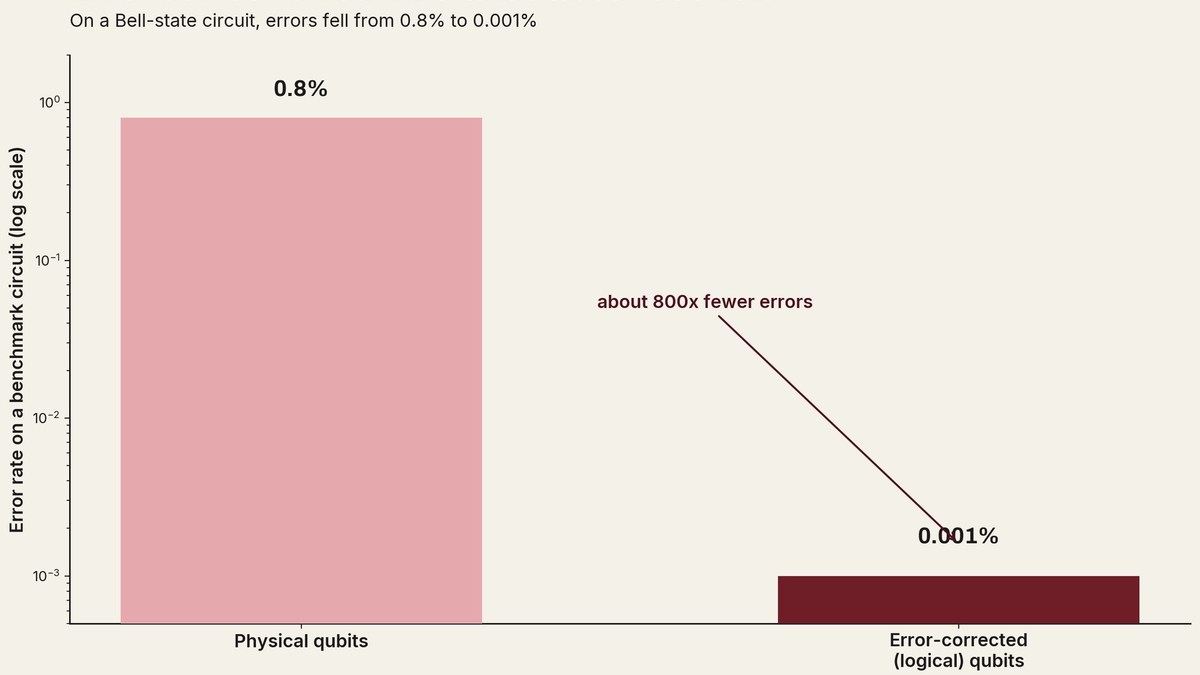
Twelve logical qubits is a laboratory demonstration, not a useful computer, which would need far more, built from millions of physical qubits. The 800-fold figure is for one benchmark circuit, and some gains rely on discarding flagged runs, which does not scale for free.
What is a logical qubit?
Because any single physical qubit is fragile, engineers spread one unit of quantum information across many physical ones and use the spares to detect and fix errors as they happen. Getting that overhead to actually reduce errors, rather than add more of its own, has been the sticking point for years.
How much did the error rates improve?
Error-corrected logical qubits beat the raw hardware by between 11 and 800 times, the 800-fold figure coming from one benchmark circuit and resting partly on discarding runs flagged as errored. The work also cut the error added per round of correction by more than 50 times, across up to twelve logical qubits.
Does this mean useful quantum computers have arrived?
No. Twelve logical qubits is a demonstration, and a genuinely useful error-corrected machine will need far more, built from millions of physical qubits. Some of the gains also rely on discarding runs that get flagged, a technique that does not scale for free.
Three verified stories, once a week.
Good news, checked against primary sources. Free.
Powered by Buttondown