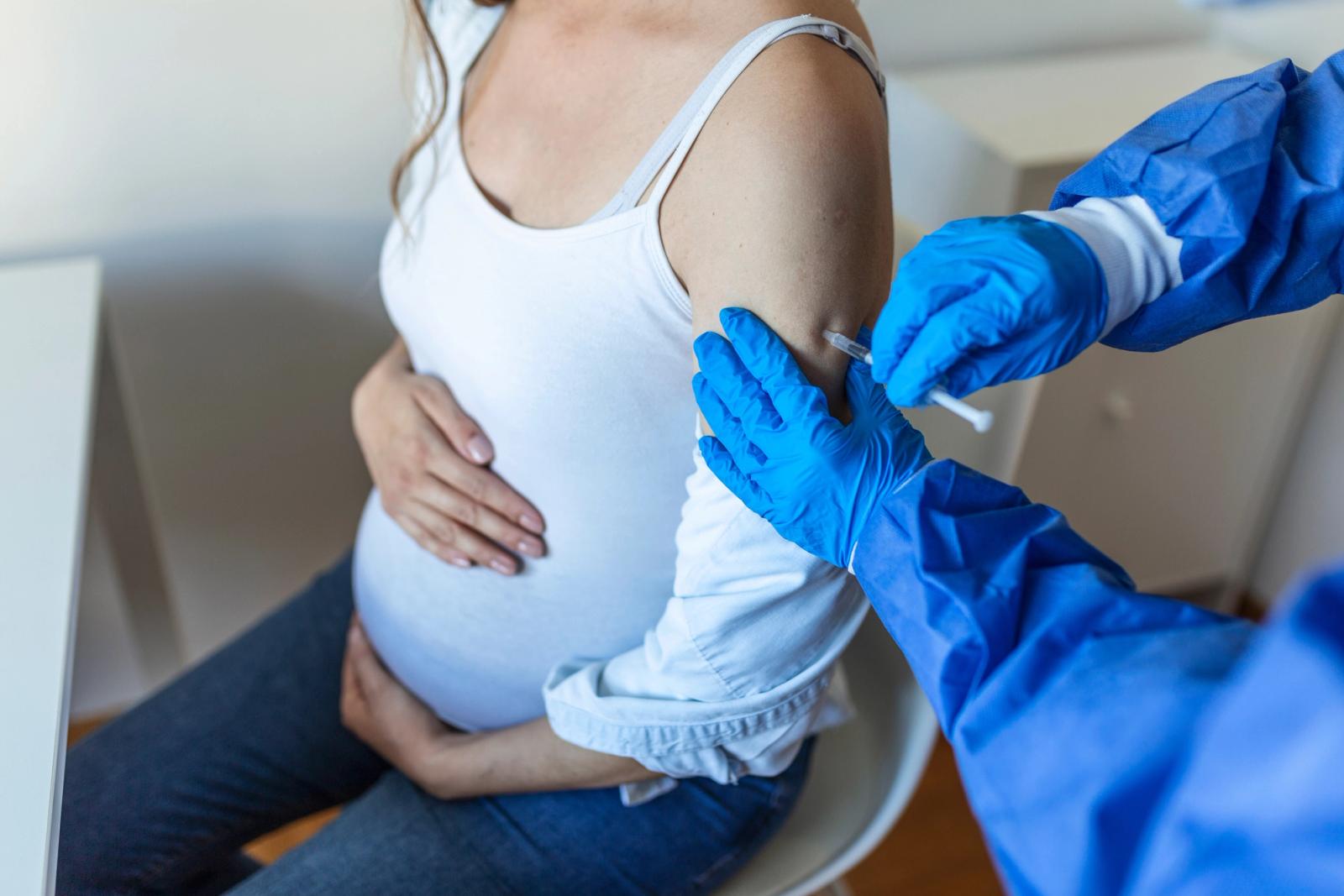
Across the 20 English hospital trusts that count them, 63 babies under six months needed intensive care for RSV last winter, against 132 the winter before. It was the first full season after the NHS began offering the vaccine to pregnant women, and about six in ten took it.
Respiratory syncytial virus, or RSV, infects around 9 in 10 children in their first two years of life, and for most of them it passes as a cold. For a few it does not. The virus can swell the smallest airways in a baby's lungs, an illness called bronchiolitis, and every winter some of the youngest need breathing support in hospital. Last winter, across the 20 NHS trusts in England that count them, 63 babies under six months went into intensive care or high dependency care, the step below it, with a confirmed RSV infection. The winter before, the same 20 trusts reported 132. The virus had not changed. What changed is that from September 2024 the NHS began offering every pregnant woman a vaccine from 28 weeks, a maternal immunisation, meaning the mother is vaccinated so that the antibodies she makes cross the placenta and protect her baby from the day it is born. Winter 2025 to 2026 was the first full season in which most newborns in England arrived already carrying that protection.
How we know
The count comes from the UK Health Security Agency's annual RSV surveillance report, published on 13 August 2026. The infant figures are drawn from SARI Watch, a system built on sentinel surveillance, meaning a small network of hospitals reports in detail rather than every hospital reporting a little. Twenty acute NHS trusts took part in both winters, and that is what makes the comparison a fair one: the same hospitals, counting the same way, either side of the programme. Across all ages those trusts recorded 196 intensive care or high dependency admissions for RSV between early September 2025 and early April 2026, against 277 in the same weeks a year earlier. Children under five accounted for 132 of the 196, down from 214. The babies under six months, the group the maternal immunisation programme is meant to reach, accounted for 63 of those, down from 132.
Two other indicators move the same way. Emergency department attendances for bronchiolitis or bronchitis among children under one totalled 18,137 across the winter, down from 22,585 the year before and 24,442 in 2022 to 2023. And the size of the fall matches what earlier studies had predicted: a population study in Scotland measured the vaccine effectiveness of the maternal jab, meaning how well it performed once rolled out to a whole population rather than inside the trial that licensed it, at 82 percent against RSV hospital admission in babies aged 90 days or younger during the programme's first season. The separate NHS programme for adults from 75 shows the same shape in its own data. RSV hospital admission rates among those aged 75 to 80 when it began ran 43 percent below what the modelling expected without it, and a pooled estimate across the four UK nations put vaccine effectiveness against RSV hospital admission at 75 percent in adults aged 75 to 79. One discrepancy is worth naming: UKHSA's news release gives last winter's infant figure as 131, where the report itself says 132 and its own percentages are consistent with 132, so 132 is the figure used here.
Why it matters
The point of vaccinating in pregnancy is timing. UKHSA's immunisation handbook is blunt about the alternative: there are no approved RSV vaccines for infants, and such an approach is unlikely to protect during the most vulnerable first months of life, because a newborn's immune system is too immature to respond well. So the protection has to arrive from outside, and a maternal immunisation is one of only two ways to deliver it, the other being an antibody injected into the baby directly. UKHSA advises the vaccine in week 28 or soon after, so that most babies born early are covered too, and says it still helps given as little as ten days before labour begins. What last winter adds is that the arithmetic holds outside a trial, across a whole health service, in a season the report describes as starting and peaking later than usual. The limit now is not the science. In the 12 months to February 2026, 61.7 percent of women giving birth in England had been vaccinated, which leaves close to four pregnancies in ten without it, and UKHSA published the result with a warning attached: many thousands of babies remain at risk. Whether those four in ten are reached is a question about maternity services and the conversations held in them, not about whether the vaccine works.
These are figures from 20 acute NHS trusts that volunteer to report in detail, not a national count, so 63 and 132 are what those hospitals saw rather than every RSV admission in England. Numbers this small also swing on their own, and UKHSA notes that the 2025 to 2026 season started and peaked later than previous ones, so ordinary season to season variation is part of what the comparison contains. The report warns separately that more testing, and so better case finding, may have offset some of the vaccine driven fall in other systems. Coverage reached 61.7 percent of women giving birth in the 12 months to February 2026, leaving close to four pregnancies in ten without the vaccine. And UKHSA's own news release gives last winter's infant figure as 131 where the report itself says 132.
Why vaccinate the mother rather than the baby?
The vaccine boosts the mother's immune system to make more antibodies against RSV, and those antibodies pass through the placenta to protect the baby from the day it is born. UKHSA recommends it in week 28 of pregnancy or soon after, so that most babies born early are covered as well. It can be given up until labour begins, and still helps given as little as ten days before birth.
Does 63 mean only 63 babies in England needed intensive care?
No. The figure counts confirmed RSV admissions to intensive care or high dependency care at the 20 acute NHS trusts that report voluntarily into UKHSA's SARI Watch network, not at every hospital in England. UKHSA states plainly that these numbers do not represent the total of RSV admissions across the country.
How well does the vaccine protect a newborn?
A population study in Scotland estimated that the vaccine given in pregnancy cut hospital admissions for RSV chest infection by 82 percent in babies aged 90 days or younger during the programme's first season, with a range of 75 to 87 percent. UKHSA has separately reported that one dose gives a newborn over 80 percent protection against being admitted to hospital.
Is there an RSV vaccine for older people too?
Yes. The NHS offers a separate RSV vaccine to adults from the age of 75, and 65 percent of those eligible in England had taken it by the end of May 2026. UKHSA's analysis found RSV hospital admission rates among people aged 75 to 80 when that programme began running 43 percent below what would have been expected without it.
- UK Health Security Agency, Surveillance of respiratory syncytial virus: winter 2025 to 2026 Primary
- UK Health Security Agency, Newborn ICU admissions drop 50% in first full year of RSV maternal vaccine programme
- UK Health Security Agency, Respiratory syncytial virus: the green book, chapter 27a
- The Pharmaceutical Journal, Maternal RSV vaccine halves newborn ICU admissions, says UKHSA
Three verified stories, once a week.
Good news, checked against primary sources. Free.
Powered by Buttondown