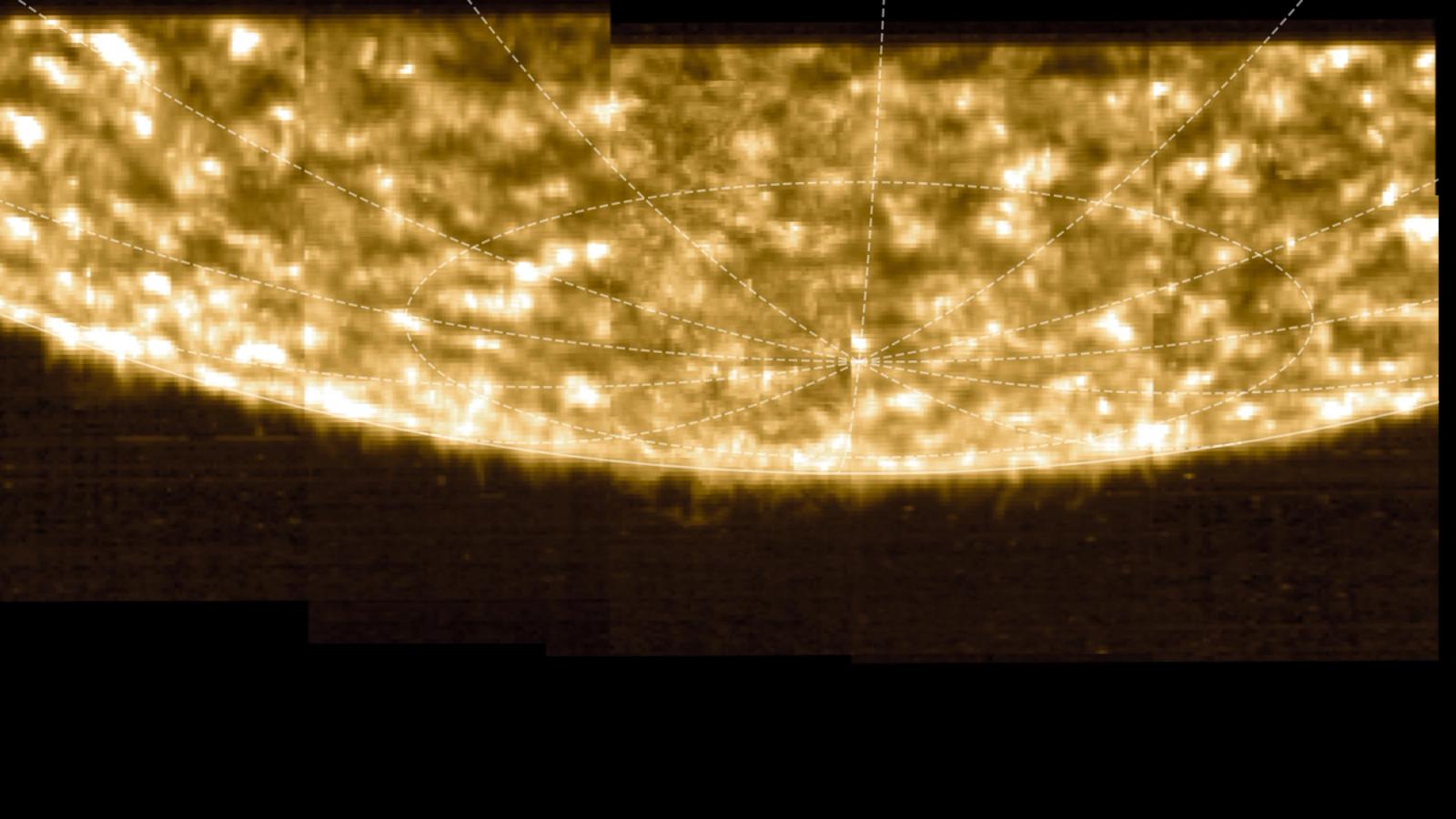
Every earlier image of the Sun was taken from close to the plane of its equator, where the poles appear edge-on. Solar Orbiter climbed out of that plane in 2025, photographed the south pole for the first time and found its magnetic field in a tangle.
Until 2025, every picture of the Sun shared a blind spot. The planets, and every spacecraft that had ever photographed the Sun, travel in a flat plane tilted at most 7 degrees from the Sun's equator, so its poles were always seen almost exactly edge-on. From there, the European Space Agency's Daniel Müller told Scientific American, the poles are effectively not visible.
In March 2025 that changed. ESA's Solar Orbiter, launched in February 2020, had used a close pass of Venus to tilt its orbit 17 degrees to the Sun's equator, and on 16 and 17 March it viewed the Sun's south pole from 15 degrees below the equator, more than twice the angle of any earlier view. The images, released on 11 June 2025, are the first ever taken of either of the Sun's poles.
What they show is a magnetic tangle. A map from the spacecraft's magnetic imager has patches of north and south polarity, the two opposite directions a magnetic field can point, jumbled together at the south pole, where in quieter years a single polarity dominates. That jumble is expected only briefly, during solar maximum, the peak of the Sun's roughly 11-year cycle of activity, when its magnetic field flips. ESA expects a single polarity to build up gradually from here, until the Sun reaches its quietest point in five to six years.
How we know
The pictures come from three of the 10 instruments on Solar Orbiter. PHI, led by the Max Planck Institute for Solar System Research in Germany, photographs the surface in visible light and maps its magnetic field. EUI, led by the Royal Observatory of Belgium, images the corona, the Sun's million-degree outer atmosphere, in ultraviolet light. SPICE, led from the Institut d'Astrophysique Spatiale in Paris, splits light into the signatures of elements such as hydrogen, carbon, oxygen, neon and magnesium.
SPICE also produced a first of its own: a map of how fast carbon ions move toward or away from the spacecraft in the thin layer where the Sun's atmosphere heats from about 10,000 degrees Celsius to hundreds of thousands, showing small plumes or jets. Comparing the three views may reveal whether swirling polar vortices exist on the Sun, as they do at Venus and Saturn. The earlier ESA and NASA mission Ulysses, which ran from 1990 to 2009, did fly over the Sun's poles, but it carried no cameras.
These are first looks. Solar Orbiter flew over the north pole in late April 2025, and ESA expected the full dataset from that first pole-to-pole pass to reach Earth by October 2025. The magnetic map matches what models predicted for this stage of the cycle, which Müller described as a tangled mess of north and south patches.
Why it matters
The poles are where the solar cycle turns over, and that cycle sets the rhythm of space weather. Outbursts from the Sun, such as flares and coronal mass ejections, can disrupt power grids and radio, interfere with navigation and communication satellites, and potentially harm astronauts. Yet current models cannot accurately predict when the Sun will reach its peak, or how strong it will be. Sami Solanki, who leads the PHI team, described the poles as unknown territory and said the spacecraft reached high latitudes at just the right time to follow the new polar field as it builds.
The cycle runs like this. At its quietest, the Sun's field resembles a bar magnet, with a strong pole at each end. As activity rises, the magnetic knots of sunspots unravel and their leftover magnetism drifts toward the poles, building a patchwork of mixed polarity. At the peak the polar fields effectively disappear, and one pole can lose its charge before the other. Then a new field of the opposite polarity grows at each pole, and the Sun settles back into a bar magnet, reversed.
The view from above matters for the solar wind too, the flow the Sun blows out across the solar system. Measurements of its speed have been limited by the grazing view of the poles, and ESA expects data from high latitudes to help explain how the Sun produces it.
The climb has only begun. A second pass of Venus on 24 December 2026 will raise the tilt to 24 degrees, and from 10 June 2029 Solar Orbiter will orbit at 33 degrees, with clearer views of both poles to come. Müller called these first images the first step on the spacecraft's stairway to heaven. For the first time, we can watch the Sun's cycle turn from above.
These are first looks at one pole from a modest angle. Much of the data from the first pass, including the north pole, was still being sent to Earth in autumn 2025, and the clearest views will only come as the tilt rises to 24 degrees from December 2026 and 33 degrees from 2029. The images match what models predicted rather than overturning them, and the timing and strength of the Sun's peak still cannot be accurately forecast.
Why had nobody photographed the Sun's poles before?
The planets and every spacecraft that had imaged the Sun travel close to the plane of its equator, so the poles were always seen almost edge-on. Ulysses flew over the poles between 1990 and 2009 but carried no cameras.
Why is the south pole's magnetic field mixed up?
The Sun is near the peak of its activity, which rises and falls over about 11 years, and at that peak its magnetic field flips and both north and south polarity appear at the poles. ESA expects a single polarity to build up gradually over the coming years.
Why does this matter on Earth?
The Sun's magnetic cycle drives space weather, such as flares and coronal mass ejections, which can disrupt power grids, radio and satellites. Better views of the poles should help scientists understand that cycle, which current models cannot accurately predict.
Three verified stories, once a week.
Good news, checked against primary sources. Free.
Powered by Buttondown