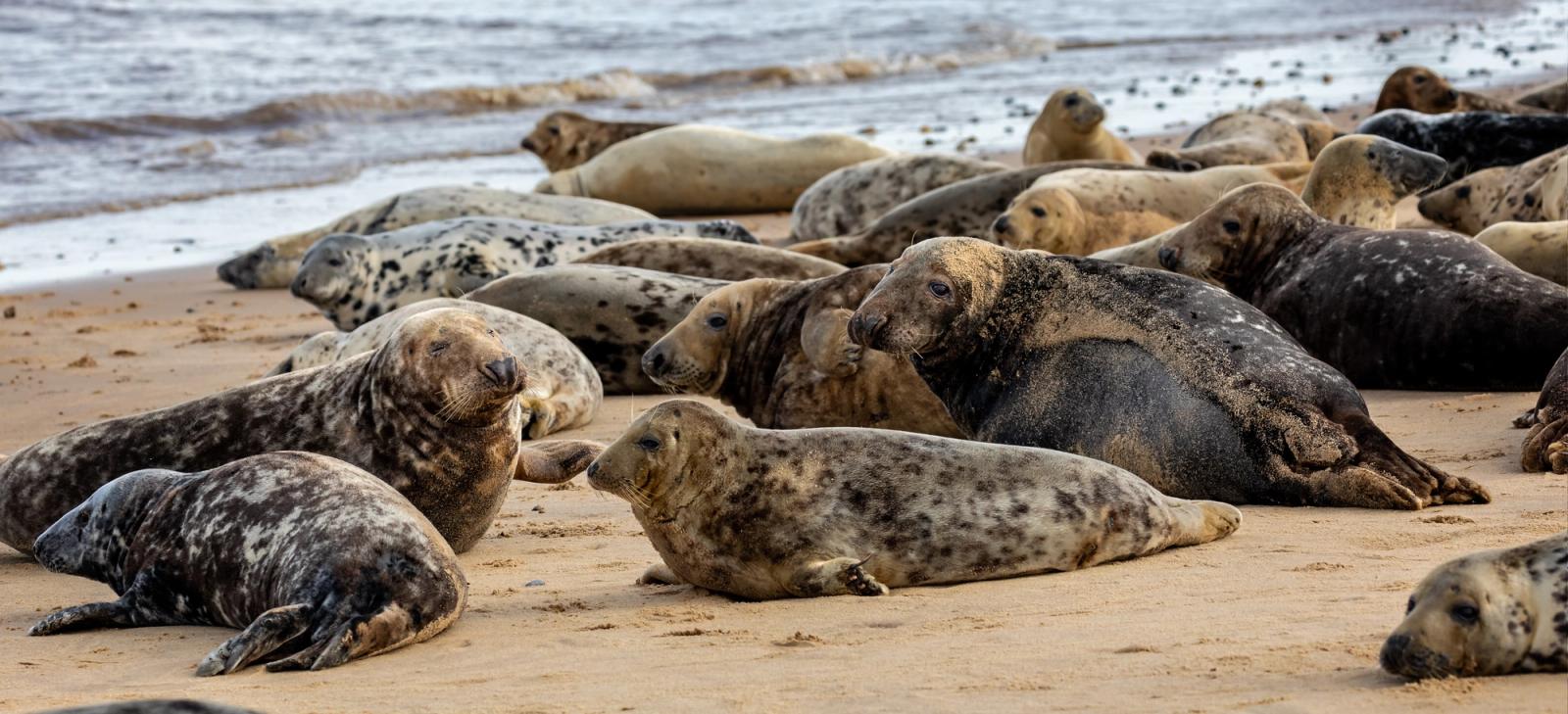
Survey flights over the Dutch, German and Danish coast counted 12,497 grey seals this spring, up from 2,139 at the first coordinated count in 2006, and 3,385 pups last winter, 11 percent more than the season before.
A grey seal pup is born white. In good conditions its mother suckles it for about three weeks on a sandbank high enough to stay dry at high tide, and the pup stays there while it sheds that white fur for a grey coat, which takes another one to four weeks, before it leaves for the sea. Last winter, 3,385 of those pups were counted along the Wadden Sea, the band of sandbanks and tidal flats on the North Sea coast of the Netherlands, Germany and Denmark, and on the offshore island of Helgoland. That is 11 percent more than the season before.
For about four centuries, there were none. Grey seals were once common here, but by the 16th century they had disappeared from the Wadden Sea completely, most likely hunted out. They began to return in the middle of the 20th century, when a small breeding colony formed in the German Wadden Sea, and since the 1980s they have been recolonising the coast and Helgoland and setting up breeding sites.
This spring, survey teams counted 12,497 grey seals, 3.6 percent more than in 2025 and more than five times the 2,139 found at the first coordinated survey in 2006, which covered only the German and Dutch coast. Leave out the 348 seals counted in Denmark, which the 2006 survey did not cover, and the rise is still more than fivefold. Over the past five years, the pup count has grown by an average of 12 percent a year and the spring count of adults by 6.8 percent a year.
Most of the seals are still in the west. The Dutch Wadden Sea held 8,981 of the animals counted this spring, nearly three in every four, and 1,731 of the pups. Helgoland was next for pups, with 1,077, and Lower Saxony third, with 575, after a rise of more than a fifth in a year. But the population is spreading east. Counts on the Schleswig-Holstein coast nearly doubled in a year, from 499 to 957, and the Danish Wadden Sea counted 348, up 45 on 2025. Pups are being born there too: one in each area during the main survey, then two more in Schleswig-Holstein and four in Denmark later in the season.
How we know
The figures come from Grey Seal Numbers in the Wadden Sea and Helgoland in 2025-2026, a report published on 1 July 2026 by the Expert Group on Marine Mammals of the Common Wadden Sea Secretariat, the joint body of Denmark, Germany and the Netherlands. Its lead author is Jessica Schop of Wageningen Marine Research. Since 2008 the three countries have coordinated their counts, surveying the sandbanks from the air in both seasons, with extra counts from land on Helgoland. Pups are counted in the pupping season, from November to January.
Adults are counted during the moult, the weeks in March and April when the seals shed and renew their fur and come ashore in large numbers to rest on the sandbanks. The researchers think hauling out, as coming ashore is called, saves the seals energy, because they spend less time in the colder water while their coat is replaced. The tally taken then is known as the moult count.
The authors are careful about what the numbers mean. Some seals are always at sea during a survey, so the counts track how the population is changing rather than its exact size, and they are most useful read across several years. A single year can swing with weather and disturbance: this spring the moult count fell by 22 percent in Lower Saxony, to 1,222, and by 7 percent on Helgoland, to 989, even as the total rose.
Why it matters
Grey seals are the largest predators on the Wadden Sea coast, and for four centuries the coast had none. A species people removed entirely has come back and is still spreading, and the way it spreads follows a pattern seen elsewhere. In the eastern Wadden Sea, pups arrive late, in late December and January. In newly established colonies in the United Kingdom, less experienced mothers tend to give birth later in the season, and in the Dutch Wadden Sea the peak of births has already moved from January to early December. The authors read the late eastern births as a sign that the breeding population there is still developing, and may keep growing.
The recovery also crosses borders. Grey seals counted in the Dutch Wadden Sea in spring travel to the United Kingdom to breed, and young seals tagged on Helgoland have crossed the North Sea and gone as far as Sweden. In the Danish Kattegat, Atlantic grey seals now overlap with the Baltic subspecies. Just outside the Wadden Sea, the Dutch Delta counted 4,267 grey seals during the 2025 moult but only 47 pups, which is why the experts want neighbouring areas brought into the annual count.
Whether the east becomes a nursery as well as a resting place is the open question. Pups need high sandbanks that stay dry at high tide, and beach tourism, shipping and water sports such as kitesurfing all add disturbance. The seals have found their way back. How much quiet sand people leave them will shape what comes next.
These are counts, not a census. Some seals are at sea during every survey and many counted here breed elsewhere in the North Sea, so the figures track the trend rather than the exact population, and single years swing with weather and disturbance. The 2006 baseline covered only the German and Dutch coast. Pups need high, quiet sandbanks, and winter storm surges, which the monitoring report ties to climate change, can wash them off and drown them.
Why did grey seals disappear from the Wadden Sea?
Grey seals were once common in the Wadden Sea but had disappeared completely by the 16th century, most likely because of heavy hunting, according to the Wadden Sea Quality Status Report. They began to return around the middle of the 20th century, breeding first in the German Wadden Sea and later in the Dutch part.
Does the count mean 12,497 grey seals live in the Wadden Sea?
Not exactly. Some seals are always at sea during a survey, and many counted in the Wadden Sea breed elsewhere in the North Sea, so the figure includes visitors as well as local animals. The experts read it as a measure of the trend rather than a headcount.
Where are the pups born?
Most are born in the Dutch Wadden Sea, which had 1,731 of the 3,385 pups counted last winter, followed by Helgoland with 1,077 and Lower Saxony with 575. Only one pup each was seen in the Schleswig-Holstein and Danish parts during the main survey, though later in the season Schleswig-Holstein counted two more and Denmark four.
What could hold the recovery back?
Grey seal pups need high sandbanks, and winter storm surges can wash them off and drown them. The Wadden Sea's monitoring report also lists disturbance from tourism, shipping and water sports as risks to the colonies.
- Common Wadden Sea Secretariat, Expert Group on Marine Mammals, Grey Seal Numbers in the Wadden Sea and Helgoland in 2025-2026 (Schop et al., 2026) Primary
- Common Wadden Sea Secretariat, Grey seal numbers in the Wadden Sea continue to grow
- dpa via Volksstimme, So viele Kegelrobben leben im Wattenmeer und auf Helgoland
- Common Wadden Sea Secretariat, Quality Status Report, Wadden Sea Quality Status Report: Marine Mammals
Three verified stories, once a week.
Good news, checked against primary sources. Free.
Powered by Buttondown